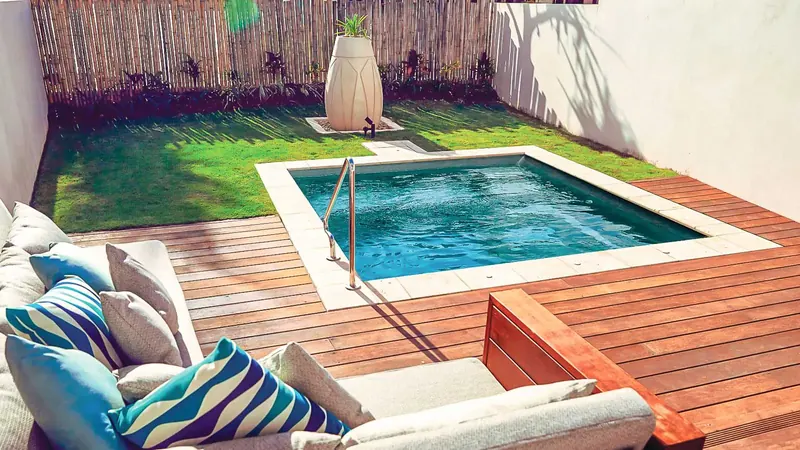
Leisure Pools fiberglass
The Fiji Plunge
Rectangle, plunge size
Starts at $400/mo*or $40,622
- 10 ft model
- About 7 ft wide
- Flat floor, about 4.5 ft deep

Quick Answer
Quick Answer: Fiberglass pools start at $40,622 (Fiji Plunge). Gunite pools (concrete) start at $55,000 for a plunge pool and $100,000 for a full-size custom pool. Fiberglass pools take 4 to 6 weeks to build, while gunite pools take 3 to 6 months. Fiberglass costs less up front and has no plaster to redo. Gunite can take almost any shape or size.
Most Tulsa families choose between two pools: fiberglass or concrete. We build both fiberglass and custom gunite pools, so we have no reason to steer you either way.
The wrong pick costs you twice, because you pay for it on day one and then live with it for decades. This guide gives you our real prices, our real build times, and the honest trade-offs between the two.
One quick note on terminology: a concrete pool and a gunite pool are the same thing. Gunite is the sprayed concrete that forms the shell, so we use both words in this guide.
Here is the short version of the comparison. All prices below are Silverado Rock starting prices, and the sections that follow explain each row.
| Category | Fiberglass | Concrete (gunite) |
|---|---|---|
| Plunge pool starts at | $45,000 | $55,000 |
| Full-size pool starts at | $50,000 | $100,000 |
| Build time | 4 to 6 weeks, shell delivery included | 3 to 6 months from contract |
| Shape and size | Set by the factory mold | Almost any shape or size |
| Interior surface | Smooth gel coat | Plaster or pebble finish |
| Surface upkeep | Gel coat wears slowly | Plaster needs resurfacing over time |
| Equipment | Jandy equipment is standard | Jandy only, at least $12,000 of it |
| Heat and chill unit | Optional | Included on full-size builds |
| Crane | Only when access is tight | Not needed |
Once you sign, your quoted price is fixed, except in one case. If the excavator hits buried rock no one could see, the dig takes longer, and the price can change.
Price is the first question almost every family asks us, so here are our numbers with nothing hidden behind a phone call.
We price fiberglass pools by length, because each shell comes from the factory in a set size.
| Size band | Pool length | Starting price |
|---|---|---|
| Plunge | Leisure plunge models | $40,622 |
| Small | Under 23 feet | $50,000 |
| Medium | 23 to 30 feet | $55,000 |
| Large | Over 30 feet | $65,000 |
Complete fiberglass pools run about $46,000 to $150,000+ once we add the yard and features. Each starting price includes installation, concrete work, plumbing, and waterline tile. It also covers Jandy equipment, pool startup, pool school, and a maintenance kit.
For a full breakdown by size, see our fiberglass pool cost post.
Leisure Pools fiberglass
Rectangle, plunge size
Starts at $400/mo*or $40,622
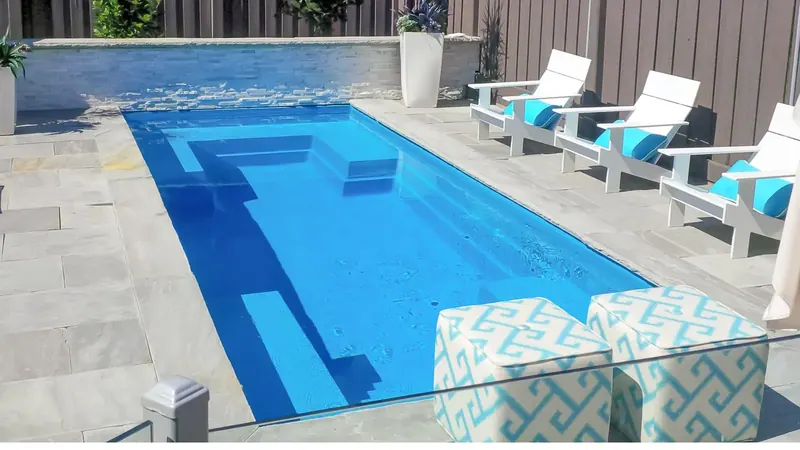
Leisure Pools fiberglass
Rectangle, plunge size
Starts at $523/mo*or $53,101
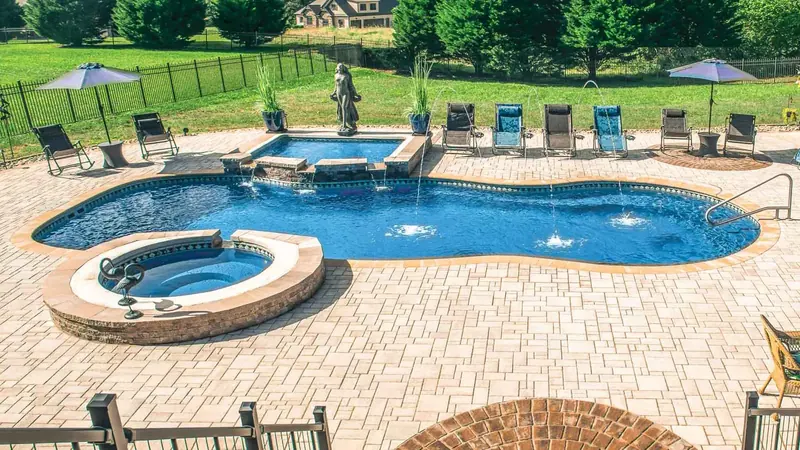
Leisure Pools fiberglass
Freeform, large size
Starts at $922/mo*or $93,631
*Example payments: $40,622, $53,101, and $93,631, each financed with $0 down at 8.5% APR for 15 years (180 monthly payments). Financing through VistaFi, subject to credit approval. Your rate depends on your credit and debt-to-income, so your APR and payment may be higher. Electrical, permit, and other extras are not included.
Gunite pricing depends on size more than anything else. A gunite plunge pool starts at $55,000, and a full-size custom gunite pool starts at $100,000.
Every gunite pool we build gets an 8-inch shell, the highest-rated rebar, and at least $12,000 of Jandy equipment. We don't offer good, better, and best equipment tiers, so every gunite family gets the same top-line gear. Every full-size gunite pool also includes a Jandy VersaTemp heat pump, which heats the water in spring and fall and cools it in July.
From there, the price climbs with size, depth, and shape, so a beach entry, a vanishing edge, or a lap lane adds cost.
What would your pool cost?
Pick a pool type to start our cost calculator. It takes about 60 seconds and shows a price range for your yard.
Not sure which type? Answer three questions and we suggest one.
National cost guides show the same basic pattern. NerdWallet pulls data from several cost sites and lists national pool costs of $20,000 to $85,000 for fiberglass and $35,000 to $120,000 for concrete.
Treat those as national benchmarks, not Tulsa quotes. Two builders can include very different work in a starting price, so always compare what each quote covers.
A few costs sit outside every starting price, for both pool types:
Rain and permit delays work differently because they can cost you time but don't add dollars to your contract.
Your yard and wish list set the rest of the price, and they are the biggest drivers we see for both pool types.
A sloped yard: A full inground pool on a slope often needs a retaining wall and fill first. That work runs $10,000 to $15,000 on our builds, and we measure every yard in person since no two slopes are the same.
Extra decking: Each starting price includes some concrete work, and extra concrete decking costs $17 to $21 per square foot.
A spa: We sell Leisure Pools inground spas, starting at about $30,000 installed. A spa works with either pool type.
Comparing quotes from other builders? Our free checklist of seven builder questions shows you what to ask before you sign. No email is needed, and you can print it for your meetings.
For many families, time matters as much as money, and this is the biggest practical gap between the two pool types.
A fiberglass build takes 4 to 6 weeks, including shell delivery. The shell is made in a factory, so most of the hard work happens before it reaches your yard.
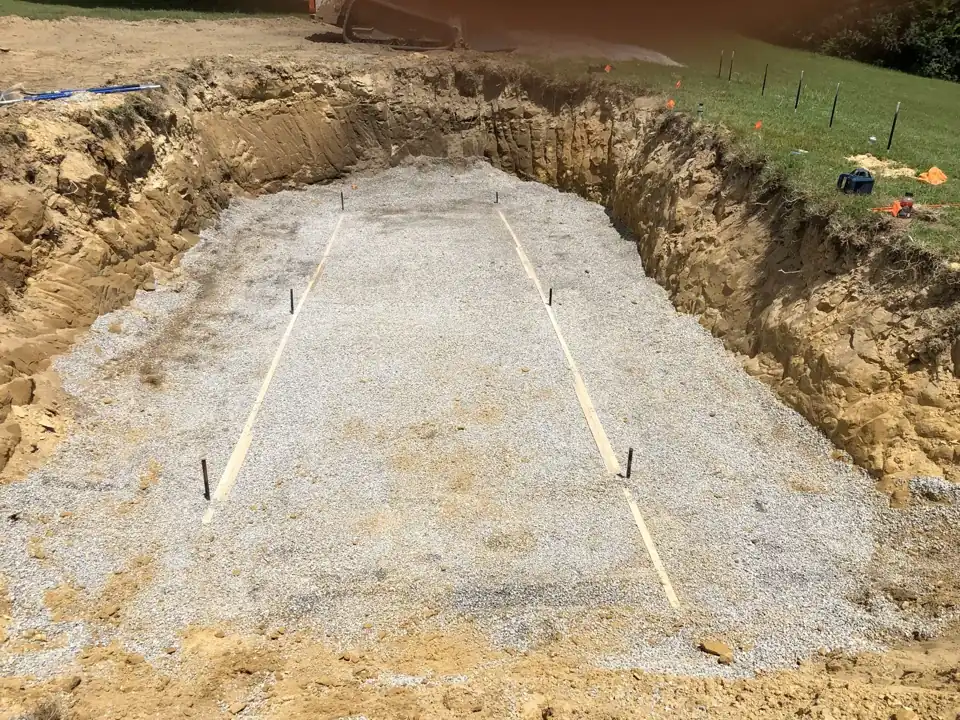
We dig the hole, set the shell on a bed of 3/8 chip stone, and then backfill, plumb, tile the waterline, and pour the deck. We hold off on swimming until the whole job is done, so your first swim happens in a finished backyard.
A gunite build takes 3 to 6 months from the day you sign, including permits, and every step happens in your yard.
We dig, set the steel, spray the shell, and then let it cure. We wet it three to five times a day for the first week, then daily until plaster. Tile, coping, plaster, and the deck come after that.
Permits take one to four weeks, depending on your city. We also add a 30-day cushion to every schedule because Oklahoma weather doesn't care about your plans.
Here is a hypothetical example, not a real customer. Two families sign on the same day in early March. The fiberglass family can expect to swim by early summer, while the gunite family may not swim until late summer or fall. That gap is a whole season of cannonballs, birthday parties, and warm evenings in the water with your kids.
For a Memorial Day swim date, plan to sign a fiberglass contract by mid-February. A gunite pool needs about seven months, so sign by the end of October the year before.
You may hear that clay soil is bad for one pool type and fine for the other, but that is not true. Any pool type can go into Tulsa clay.
Clay swells when it gets wet and shrinks when it dries out. The USGS Swelling Clays Map shows where these soils occur across the country.
You can look up the soil on your own lot with the USDA Web Soil Survey. The tool is free, and it shows the soil types under any address you enter.
Pool type doesn't determine how a pool handles clay; the base, backfill, drainage, and deck prep do. A careful build works in clay, while a shortcut build can fail in any soil.
We set every fiberglass shell on at least 4 inches of 3/8 chip stone, and some spots get 5 to 7 inches. Then we backfill around the shell with the same stone and compact it dry, with no water jetting.
Small crushed stone locks together when packed, and water drains through it instead of sitting on top. A typical build takes 80 to 100 tons of stone.
Many builders use sand because it is cheap, but sand holds water, and wet sand can shift and wash out. We have replaced a deck around a sand-backfilled pool built by another company. You can see why we never use sand in our fiberglass backfill post.
A gunite pool gets its strength from the shell itself, so we build every gunite shell 8 inches thick with the highest-rated rebar.
Both pool types get one more safeguard. We set a pipe in the chip stone at the deep end that runs up to a cap in the deck. If groundwater builds up under the pool, a pump can drop into that pipe and pull the water out.
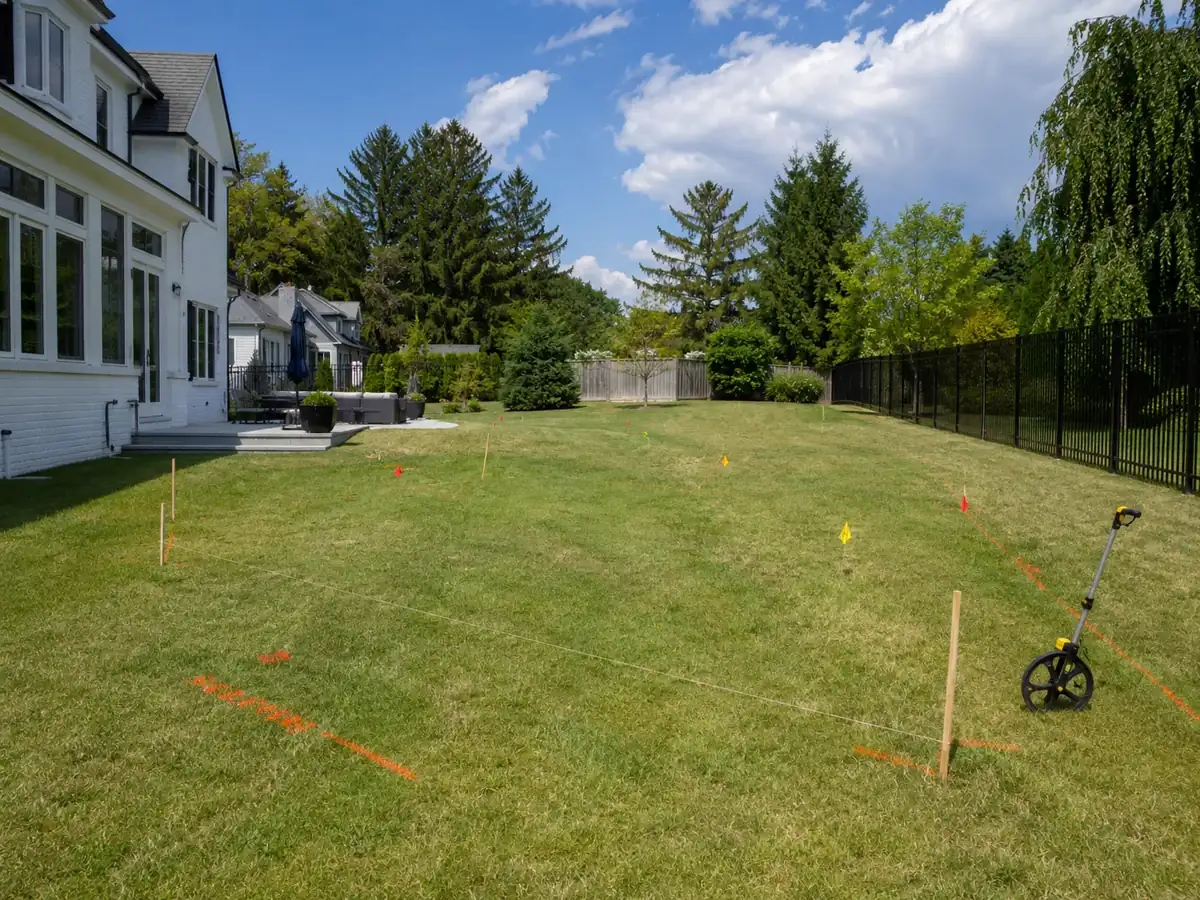 Want to know what your yard can hold?Get My Free Yard CheckJason calls first to set a time. Your yard notes arrive within a day.
The price you pay on day one is only part of the story, because the pool surface drives much of what you spend later.
A fiberglass pool has a gel coat surface that feels smooth to the touch and stays smooth for years.
We install Leisure Pools shells, which are built with vinyl ester resin. Leisure backs each shell with a lifetime structural warranty, a lifetime structural osmosis warranty, and the gel coat carries a 10-year warranty. You can read the details on the Leisure shell warranty page.
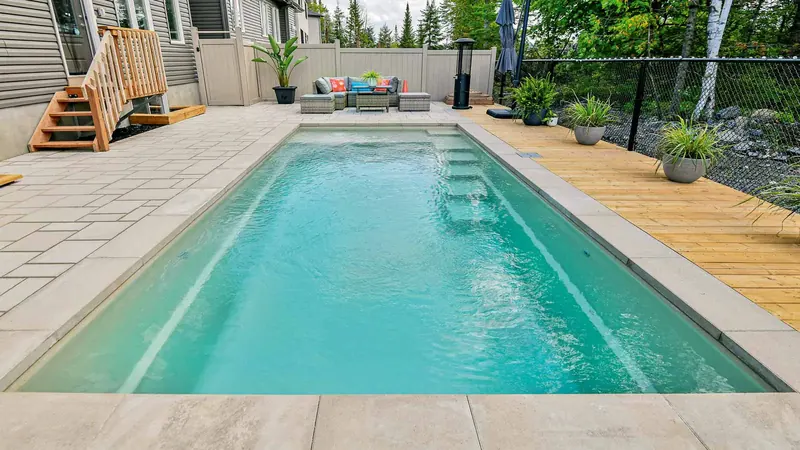
Leisure Pools fiberglass
Rectangle, small and medium sizes
Starts at $550/mo*or $55,882
*Example payment: $55,882 financed with $0 down at 8.5% APR for 15 years (180 monthly payments). Financing through VistaFi, subject to credit approval. Your rate depends on your credit and debt-to-income, so your APR and payment may be higher. Electrical, permit, and other extras are not included.
We tile the waterline on every fiberglass pool we build. Tile helps prevent fading and chalking along the waterline and guards the edge from dog claws.
The gel coat is the part that wears, and its quality varies from one maker to the next. If it ever wears out, we resurface the whole pool instead of patching it, because patches rarely match.
A gunite pool is finished with plaster or a pebble finish. Concrete is porous and can harbor algae, so it takes more chemicals and more brushing than a gel coat surface.
Plaster also wears over time, and national cost data puts plaster resurfacing at about $5,500 per 1,000 square feet. HomeAdvisor gives two answers on timing. Its resurfacing cost data says a solid plaster job lasts 5 to 10 years. Its inground pool guide says to resurface every 10 to 15 years.
Pebble finishes, such as Pebble Sheen, cost more up front but last longer than plain plaster. Pebble finishes also feel textured, which some families like for grip, while others find them rough on bare feet.
Power costs are about equal because the pump is the biggest power draw on any pool. We use Jandy variable-speed pumps on both types, and we program the pump speeds before handoff.
At 600 RPM, our pumps draw about 39 watts, and at 1,200 RPM they draw about 95 watts. At low speed, that is less power than an old 60-watt light bulb.
Winter care is the same for both types. We close pools for winter starting at $350, which includes blowing out the lines and putting on your existing cover.
Here is a hypothetical 16x32 pool, not a real customer, to show how the costs stack up. Our prices are starting prices, and the resurfacing figure is a national benchmark, not a Tulsa quote.
| Cost over 10 years | Fiberglass, 16x32 | Gunite, 16x32 |
|---|---|---|
| Starting price | $65,000 | $100,000 |
| Resurfacing | None expected | About $3,300, once |
| Chemicals | Lower | Higher, due to the porous surface |
| Starting total | About $65,000 | About $103,300 |
HomeAdvisor lists about $3,300 to resurface a 16x32 pool, which is where that figure comes from. If the plaster lasts more than 10 years, the gunite pool skips that cost. If it wears fast, it could need two resurfacings in the same span.
We didn't include dollar figures for chemicals because water care costs vary too much from one family to the next. The direction is clear, though, since a porous surface needs more sanitizer and more brushing.
This is the one category where concrete has a clear edge. If your dream pool does not exist in any factory mold, gunite is the answer.
Gunite pools are built in place so that they can take almost any shape, size, or depth. A long lap lane, a beach entry, a deep end for diving, and benches anywhere are all on the table.
Sloped yards are where gunite really shines, because a Tulsa lot that falls away can hold a vanishing edge that spills toward the view. Many builders see a slope as a problem, but we see a design feature.
A fiberglass shell is built in a factory and shipped by truck, so the mold sets the shape and road limits cap its width.
Even so, choices are wide, since Leisure Pools makes plunge pools, family pools, and long rectangles with built-in steps and benches. Some fiberglass makers even sell infinity-edge models, so a vanishing edge isn't limited to gunite.
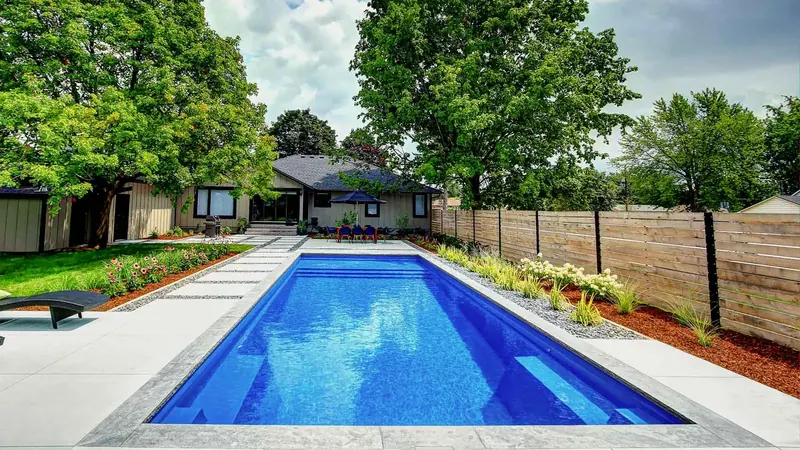
Leisure Pools fiberglass
Rectangle, medium and large sizes
Starts at $731/mo*or $74,257
*Example payment: $74,257 financed with $0 down at 8.5% APR for 15 years (180 monthly payments). Financing through VistaFi, subject to credit approval. Your rate depends on your credit and debt-to-income, so your APR and payment may be higher. Electrical, permit, and other extras are not included.
You can add a spa to either pool type, but we suggest keeping the spa separate from the pool. A separate spa stays open all winter after the pool closes, and it provides real hydrotherapy that an attached spa cannot match.
Both pool types are built to last decades, so the real difference is which parts need work over time.
A fiberglass shell should last 50 years or more when installed right, and the installation determines that number. A shell on packed chip stone has firm support for life, while a shell on washed-out sand does not.
On a gunite pool, the shell is built to last, while the plaster or pebble surface needs work over the years. Plan for at least one resurfacing in your budget if you choose gunite.
Families bring a lot of advice to our first meeting, and some of it costs people money. These two myths come up more than any others.
Myth 1: Concrete is always the premium choice. Gunite costs more because you build it by hand in your yard, not because it is the best pool for every family. A fiberglass pool that fits your yard is not a step down.
Myth 2: Fiberglass pools are small. Plunge pools get a lot of attention, but fiberglass shells also come in long family sizes, and our large band covers pools over 30 feet.
Two quotes for the same pool can differ widely because they cover different work. Lay them side by side and ask these seven questions.
A builder who answers all seven with ease has done this many times. A builder who dodges the questions is telling you something too.
 Talking to pool builders soon?Get the ChecklistSeven questions to ask before you sign. Free to print.
Most families can tell which side they are on after reading the two short lists below.
Choose fiberglass if:
Choose gunite if:
Still not sure? That is normal, and the quiz at the end of this page takes about 90 seconds to point you toward the right type.
I build both, and I'll quote you both. I don't care which one you pick. What I care about is that the pool fits your yard, your budget, and your family.
Pick gunite for the right reason: Choose gunite because you want something a mold can't give you. Don't choose it because you think concrete is tougher. Both pools last a long time when they're built right.
Pick fiberglass for the right reason: If a factory shape fits your yard, fiberglass gets you swimming months sooner for less money. That's more summer evenings with your kids.
Ask about the base, not just the brand: The install decides how any pool ages. Ask every builder what goes under and around the pool, and listen closely.
Start simple on water care: On a fiberglass pool, keep free chlorine at 2 to 3 ppm and log your water once a month, because the Leisure warranty asks for it. If you want salt, we can add it now or later.
Sign early: Winter is the best time to plan a summer pool. You get your pick of dates and room for bad weather.
It depends on what you want from the pool. Fiberglass is better for most families who want a proven shape, a faster build, and less surface upkeep. Concrete is better when you want a custom shape, size, or depth that no mold offers.
Yes, in most cases. At Silverado Rock, fiberglass pools start at $45,000, and most full-size fiberglass pools start between $50,000 and $65,000. A gunite plunge pool starts at $55,000, and a full-size custom gunite pool starts at $100,000.
Yes. Gunite is sprayed concrete that forms the pool shell, so people use "gunite pool" and "concrete pool" to mean the same thing. Shotcrete is a close cousin that is also sprayed concrete.
A fiberglass pool takes 4 to 6 weeks to build, including shell delivery. A gunite pool takes 3 to 6 months from the day you sign, including permits. Permits take one to four weeks, depending on your city.
Neither pool type wins on clay, and any pool type can go into Tulsa clay. The base, backfill, drainage, and deck prep determine how well a pool handles clay soil over time.
Fiberglass usually costs less to keep up because its smooth gel coat surface never needs plaster work. Concrete is porous, so it needs more chemicals and brushing, and its plaster needs resurfacing over time.
A fiberglass shell should last 50 years or more when installed correctly, and the gel coat is the part that wears. Leisure Pools backs its shells with a lifetime structural warranty and a 10-year gel coat warranty.
Yes, in some cases, because some fiberglass makers sell infinity edge models. A gunite pool gives you more freedom, though, because you can build the edge to any length to fit your slope.
Yes. We build fiberglass pools with Leisure Pools shells, custom gunite pools, and semi-inground vinyl liner pools. We serve Tulsa and the nearby cities, and we quote both types side by side.
Still deciding between fiberglass and concrete? Find your perfect pool. Answer a few quick questions about your yard, and we'll show you the pool type and features that fit your plans.
About the Author
Jason
Jason is the founder of Silverado Rock and has spent more than 29 years building custom inground and semi-inground pools across the Tulsa metro area. He handles every client consultation personally and specializes in hydraulics-optimized construction, Oklahoma clay soil prep, and custom rock surround and waterfall design. If you are planning a pool in Tulsa, Broken Arrow, Bixby, Jenks, Owasso, or the surrounding area, call Jason directly at (918) 230-4997.

About 90 seconds. No measurements or photos needed.