

Leisure Pools fiberglass
The Fiji Plunge
Rectangle, plunge size
Starts at $400/mo*or $40,622
- 10 ft model
- About 7 ft wide
- Flat floor, about 4.5 ft deep

Quick Answer
Quick Answer: Yes, many families with less-than-perfect credit can finance a pool. Our lending partner, VistaFi, looks at all credit profiles and lists a 620 minimum score on its pool pages. A lower score means a higher rate, so the same pool costs more each month. If your score is between 600 and 619, check your rate anyway, because VistaFi can still review your file.
A low credit score can feel like a locked gate standing between your family and the backyard pool you have pictured for years.
Here is the good news for many Tulsa families: that gate is not locked, but it does cost a little more to open. You can check what you qualify for on our financing page without touching your credit score.
This guide shows the score our lending partner looks for and how a lower score affects your monthly payment. You will get five ways to improve your odds and the one move that saves more money than any rate shopping.
Each lender draws its own line, so "bad credit" at one lender can count as "fair credit" at another. The real question is how low your score sits today and which lenders will work with it.
FICO sorts credit scores into five groups, from poor at the bottom to exceptional at the top. The fair credit score range runs from 580 to 669, and Experian puts the average FICO Score at 713 in 2025.
FICO range | Label | What it means for a pool loan |
|---|---|---|
800 to 850 | Exceptional | Best rates and longest terms |
740 to 799 | Very good | Strong rates at most lenders |
670 to 739 | Good | Approved at most lenders |
620 to 669 | Fair | Approval is possible, at a higher rate |
580 to 619 | Fair | Below the listed minimum, but 600 and up is worth a rate check |
300 to 579 | Poor | Very hard to finance a pool right now |
A 650 score is not a dead end, and even a 560 score means "not yet" rather than "never."
VistaFi lists a minimum credit score of 620 on its VistaFi pool loans page. VistaFi's current materials list loans from $15,000 up to $400,000, based on your income and credit. Terms run up to 30 years at a fixed rate, and VistaFi says its loans carry no prepayment penalty.
If your score sits between 600 and 619, do not rule yourself out. VistaFi's team told dealers it can review applications down to 600, so a free rate check is worth trying. Expect a smaller approval amount at that level, which is why pool size matters so much here.
VistaFi is not a lender. It connects families with partner lenders for unsecured home improvement loans. "Unsecured" means your house is not the collateral, so there is no appraisal and no lien on your home.
The VistaFi loan requirements page says it considers all credit profiles, from excellent to those still rebuilding. It also says the paperwork is light, usually proof of identity and income.
Good to know: Checking your rate through VistaFi uses a soft credit check. A soft check doesn't change your score, and the full credit check happens only once your application moves to underwriting.
Fair credit raises your interest rate, and a higher rate raises your monthly payment on the same pool.
In October 2026, our contact at VistaFi shared the rates borrowers were seeing at different credit scores. Borrowers near 800 got rates around 8% to 8.5%, while borrowers near 650 were closer to 12%. Scores nearer 620 should expect to pay more than that, depending on income and existing debt.
Here is what that rate gap looks like in monthly payments on a typical 15-year unsecured pool loan.
Amount borrowed | 8.5% APR (score near 800) | 12% APR (score near 650) | Extra interest over 15 years |
|---|---|---|---|
$20,000 | $197/mo | $240/mo | $7,755 |
$40,000 | $394/mo | $480/mo | $15,511 |
$50,000 | $492/mo | $600/mo | $19,388 |
$65,000 | $640/mo | $780/mo | $25,205 |
Each example assumes a fixed APR, no down payment, and 180 equal monthly payments. These are math examples, not loan offers, and your actual rate comes from the lender.
On a $65,000 loan, about the price of our finished 14x28 semi-inground package, fair credit costs about $140 more each month. Over 15 years, that adds up to more than $25,000 in extra interest.
That is not a reason to give up, but it is a reason to know your number before you sign anything. Our pool loan calculator lets you test your own amount, rate, and term.
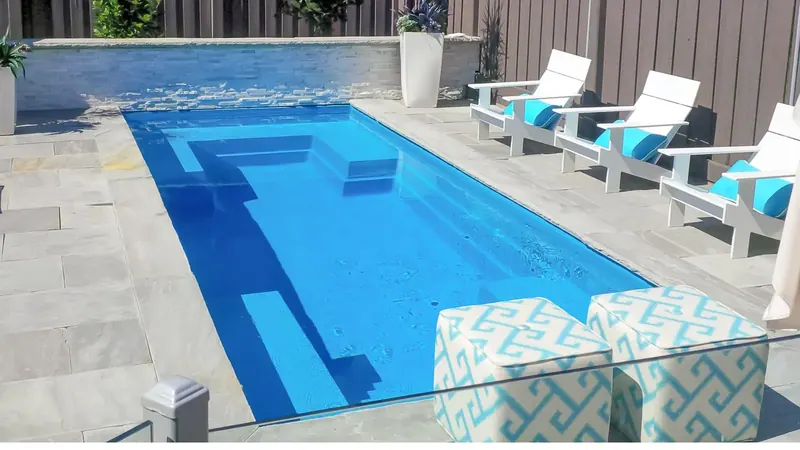
Leisure Pools fiberglass
Rectangle, plunge size
Starts at $400/mo*or $40,622
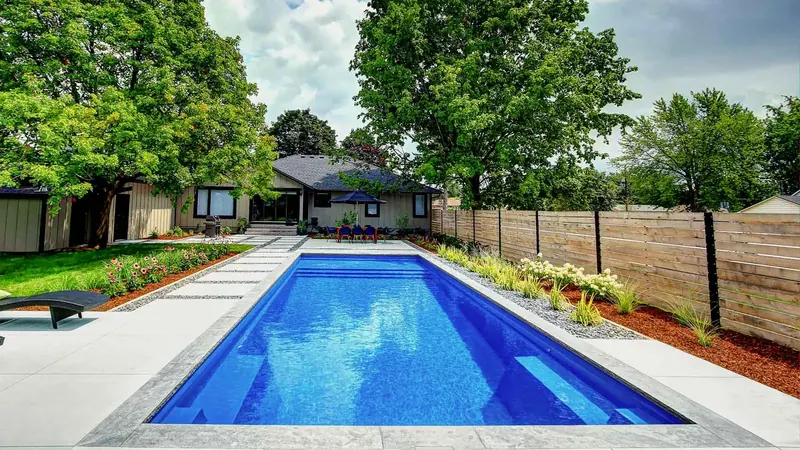
Leisure Pools fiberglass
Rectangle, plunge size
Starts at $523/mo*or $53,101
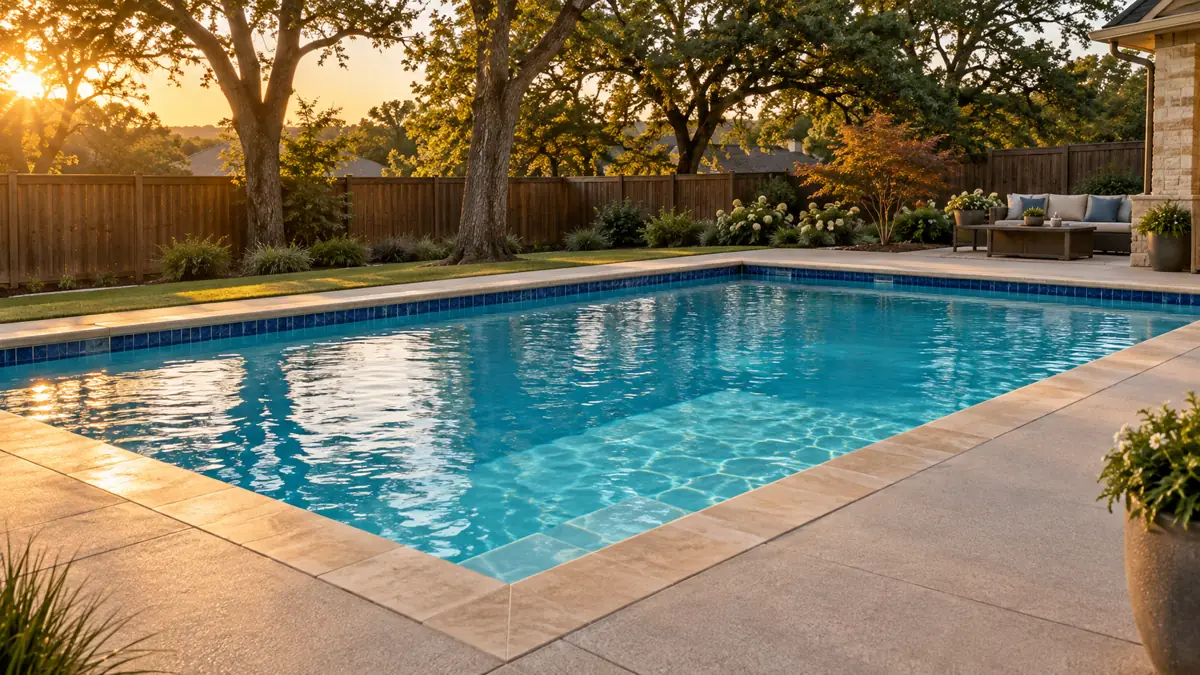
Leisure Pools fiberglass
Rectangle, medium and large sizes
Starts at $731/mo*or $74,257
*Example payments: $40,622, $53,101, and $74,257, each financed with $0 down at 8.5% APR for 15 years (180 monthly payments). Financing through VistaFi, subject to credit approval. Your rate depends on your credit and debt-to-income, so your APR and payment may be higher. Electrical, permit, and other extras are not included.
If you are between 600 and 619, start with a free rate check before anything else. Below that, you still have real options, and none of them involve a shady lender.
Some online lenders do accept lower scores, but the price of that approval is steep. Bankrate's survey of personal loan rates says most lenders want a score of about 580. It also says borrowers with poor credit can see APRs as high as 36%, the top rate for most personal loans.
Here is what a 36% rate does to a pool loan compared with 12%. We used the same five-year term for both rates, so the comparison is fair.
Amount borrowed | 12% APR, 5 years | 36% APR, 5 years | Extra interest at 36% |
|---|---|---|---|
$20,000 | $445/mo | $723/mo | $16,666 |
$40,000 | $890/mo | $1,445/mo | $33,332 |
At 36%, a $40,000 loan costs about $1,445 a month, which is a mortgage-size payment for a pool. Over five years, that rate adds more than $33,000 in interest compared with a 12% loan of the same length.
A home equity loan uses your home's value instead of your score alone, but it is not an easy back door. Chase explains that each lender sets its own home equity scores, and strong equity or steady income can help a borrower near the minimum. The catch is that your house becomes the collateral, so a missed payment puts your home at risk.
Start with the two factors that carry the most weight in your score. myFICO shows that payment history accounts for 35% of your score, while amounts owed accounts for 30%.
That means two habits do most of the work: pay every bill on time, and keep your card balances low compared to your limits.
You can get free credit reports from Equifax, Experian, and TransUnion every week at AnnualCreditReport.com. The FTC says that is the only site authorized to fill those free orders.
Read every line carefully, and look for accounts you never opened, late payments you made on time, and old debts that should have dropped off.
Lenders also check your debt-to-income ratio, which is your monthly debt payments divided by your gross monthly income.
In the CFPB's example, a household that earns $6,000 a month before taxes and pays $2,000 toward debts has a 33% ratio.
If that family adds a $480 pool payment, their debts climb to $2,480, and their ratio rises to about 41%. Paying off a small car loan or credit card first frees up room in that ratio for the pool payment.
No. The FTC is clear about what these companies can and cannot legally do for you.
The FTC's guide to fixing your credit says no one can legally remove accurate, current negative information from your report. It also says anything a credit repair company can do legally, you can do yourself at little or no cost.
Watch for these red flags from any company that offers to fix your credit:
If you see any of these signs, walk away and keep your money. That fee would do more for your score if you used it to pay down a card balance.
Most families think the interest rate is the biggest number to fix, but the loan amount matters more.
Picture a family with fair credit that borrows for the starting price. Then the finished yard adds decking, a fence, permits, dirt hauling, and electrical, so they need a second loan and their score takes another hit.
Our /learn/pool-cost walks through the full number before you borrow. This post on our pool quotes shows what we include and what you pay others directly.
Borrow once, for the finished backyard with decking and fencing. That one move protects your score better than any rate trick.
Here is the order we suggest to families across Tulsa, Broken Arrow, Jenks, Owasso, Glenpool, and Bixby.
For a deeper look at loan types, rates, and home equity options, read our full pool financing guide.
A loan offer can look cheap on the payment line and still cost you thousands more over its full life. Ask every lender these six questions, and get the answers in writing.
If anyone pushes you to sign today based only on the monthly payment, slow down and walk away from that offer.
I've been a Tulsa pool builder for 29 years, and I've met plenty of families who thought their credit ruled them out. Most were much closer than they thought.
Here's what I'd do with a score in the low 600s. Check your rate first, because it's free and it won't touch your score. If you qualify, pick a pool that keeps the payment comfortable, not one that stretches you thin.
If you don't qualify yet, don't chase a 36% loan. On $40,000, that's about $1,445 a month for five years. I'd rather you wait a few months and come back with a payment you can carry. A pool should feel like a gift every summer, not a monthly weight.
And if you need to start smaller, that's a perfectly smart move. A plunge pool now still gives your kids those long evenings in the water. You can add the outdoor kitchen later, when your credit is stronger.
It is harder, but worth trying. VistaFi lists a 620 minimum on its pool pages, but its team says it can review scores down to 600, so check your rate first. If you do not qualify, a co-borrower, a smaller loan, or a few months of credit work can open the door.
Each lender sets its own minimum, and secured loans follow different rules than unsecured ones. Bankrate reports that most personal loan lenders look for about 580. VistaFi lists a 620 minimum score for its unsecured pool loans. The best rates go to scores near 800, which were seeing about 8% to 8.5% in October 2026.
Checking your rate does not hurt your credit when the lender uses a soft check. VistaFi uses a soft credit check to show your rate, and a soft check does not change your score. A full credit check only happens once your application moves to underwriting.
In October 2026, VistaFi borrowers with scores near 650 were seeing rates around 12%, and scores closer to 620 should expect higher rates. On a $50,000 loan over 15 years, 12% means about $600 a month.
Yes. A spouse or partner with a stronger score and steady income can help you qualify and may lower your rate. Both of you are responsible for the full loan, so missed payments hurt both credit reports.
No. The FTC says no one can legally remove accurate negative information from your report. You can pull your free reports, dispute errors, and pay down balances yourself at little or no cost.
Bad credit does not have to mean no pool. Pool financing with bad credit starts with one free rate check that will not touch your score. From there, we will walk your yard, price the finished project, and help you pick a pool that fits your budget today. Your kids only get so many summers at home, so start with the step that costs you nothing.
About the Author
Jason
Jason is the founder of Silverado Rock and has spent more than 29 years building custom inground and semi-inground pools across the Tulsa metro area. He handles every client consultation personally and specializes in hydraulics-optimized construction, Oklahoma clay soil prep, and custom rock surround and waterfall design. If you are planning a pool in Tulsa, Broken Arrow, Bixby, Jenks, Owasso, or the surrounding area, call Jason directly at (918) 230-4997.
See your monthly payment first. Checking your rate will not change your credit score.